Guide
Can robot vacuums clean stairs or multiple floors?
Published
Note: This page contains affiliate links. If you buy through them we may earn a commission at no extra cost to you. Learn more
In short
No mainstream robot vacuum on sale can climb or clean stairs. Cliff sensors underneath stop them falling down a staircase, and most mapping robots store several floor maps, so you can carry one robot between floors. For the stairs themselves you still need a handheld or cordless vacuum.
Products for this job
Compare all 6 productsRoborock Saros 10R: 22,000 Pa HyperForce suction
Check price on AmazonAffiliate linkEcovacs Deebot T80S Omni: 24,800 Pa, roller lifts 15 mm
Check price on AmazonAffiliate linkiRobot Roomba Combo 10 Max: mop retracts to top of robot
Check price on AmazonAffiliate link
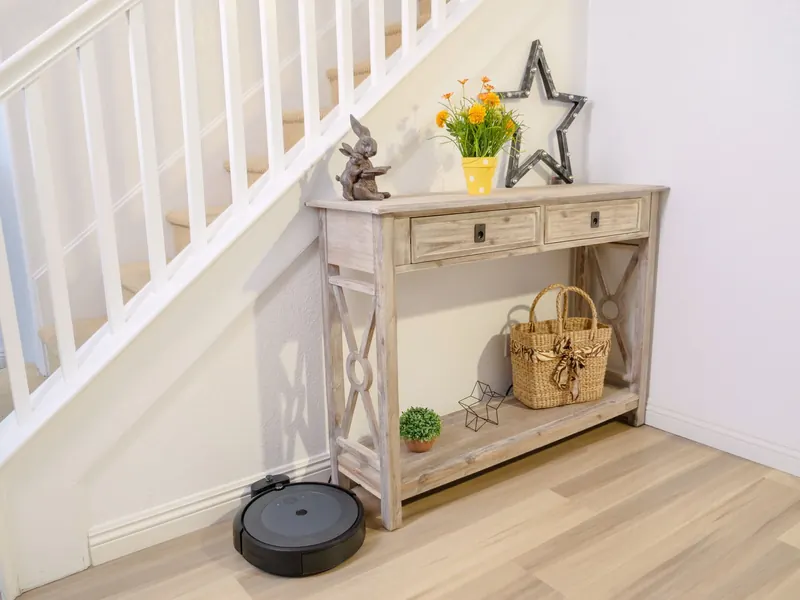
In a two-storey UK house, the staircase is often the dustiest strip of carpet, and it is exactly where a robot vacuum cannot go. Robots are built to stay on one level: they detect the top step and turn away. This explainer covers how cliff sensors work, how to run one robot on more than one floor, the options for a second dock or second robot, and where the stair-climbing designs shown by some makers fit in.
Why robot vacuums cannot clean stairs
A robot vacuum is a flat disc on two drive wheels. Climbing a step needs the robot to lift its whole body by the height of the riser, which in a typical home is far beyond the 2 to 6 cm that even the best climbing robots manage over thresholds. Cleaning a stair tread also means working on a narrow, deep shelf with a drop on one side, then repeating that for every step.
So the mainstream answer is clear: no robot vacuum you can buy from the main brands today cleans a staircase. Robots clean each floor, and the stairs stay a job for a cordless stick or handheld vacuum.
How cliff sensors stop robots falling down stairs
Underneath the front edge, most robots have several cliff sensors. These are small infrared sensors that point at the floor and measure the reflected light. When the floor suddenly drops away, as it does at the top of a staircase, the signal changes and the robot stops, reverses and turns. Mapping robots also remember where the drop is, so they plan around it on later cleans.
Cliff sensors are reliable, but they have known weak spots. Very dark or black floors and rugs can absorb the infrared light and look like a drop, so the robot refuses to cross them. Dirty sensors can do the same. Wiping the sensors with a dry cloth is part of routine maintenance; see how to clean a robot vacuum.
- Keep the cliff sensors clean with a dry microfibre cloth.
- Add a no-go zone along the top of the stairs for extra safety.
- Watch the first few cleans near a landing or open stairwell.
- Check the manual before covering sensors for dark rugs; it can disable stair protection.
Note:Never cover or tape over cliff sensors in a home with stairs or a step-down room. If a robot does fall, check it for damage and have the battery inspected by the maker's service before charging it again if the casing is cracked.
Using one robot on more than one floor
Most robots with lidar or camera mapping can store several maps. Carry the robot to the other floor, place it on the floor and start it, and on many models it recognises which map it is on and cleans by room as normal. Listings such as the eufy L60 and Tapo RV30 Max Plus mention multi-floor mapping; the number of maps varies by model.
The catch is the dock. The robot only charges, self-empties and washes its mops at its own dock, so on the second floor it cleans until the job is done or the battery runs low, then stops. You then carry it back to the dock. For a small upstairs with a couple of bedrooms and a landing, that is often fine. For a large second floor it can become a chore.
- 1
Map the floor where the dock lives first.
- 2
Carry the robot upstairs, place it in an open area and start a mapping run from the app.
- 3
Save the new map and name the rooms.
- 4
For later cleans, carry it up, start it, and bring it back to the dock afterwards.
Second dock, second robot or a handheld?
Some makers sell spare charging docks, which let the robot recharge on either floor, although a basic charging dock will not self-empty or wash mops. Other households buy a second, simpler robot for upstairs, often a model without a large all-in-one dock because bedrooms are mostly carpeted and need vacuuming rather than mopping.
Whatever you choose for the floors, the stairs themselves need a cordless stick or handheld vacuum. Robots with good carpet performance suit bedroom floors; see our carpet guide. For self-emptying downstairs models, see our self-emptying guide.
| Option | Good for | Limitation |
|---|---|---|
| Carry one robot between floors | Small upper floor | No dock upstairs |
| Spare charging dock upstairs | Larger upper floor | Usually no self-emptying there |
| Second robot upstairs | Daily cleaning on both floors | Two robots to maintain |
| Cordless or handheld vacuum | The stairs themselves | Manual |
What about stair-climbing robot vacuums?
A few makers have shown concept or prototype robots that use legs, tracks or a lifting body to tackle steps, and the lifting legs on some current premium robots for thresholds point in that direction. These designs have been widely reported as demonstrations, but they are not mainstream products and it is too early to say how well they would clean real UK staircases, with their varied riser heights and carpet runners.
If a stair-climbing robot does reach UK shops, look carefully at the maker's stated step height, whether it actually cleans the treads or just moves between floors, and how it handles a stair carpet. Until then, plan for a robot per floor or a carried robot.
Frequently asked questions
Can you use a Shark robot vacuum upstairs and downstairs? Yes, you can carry it between floors and it will clean from the button. Whether it can store a separate map for each floor depends on the model, so check the Shark app or the maker's support pages.
How does a robot vacuum not fall down stairs? Infrared cliff sensors under the front edge detect the drop at the top step, and the robot stops and turns away. Keep the sensors clean so they work reliably.
Why will my robot not cross a black rug? Dark surfaces can absorb the infrared light from the cliff sensors and look like a drop. Some apps offer a setting for this, but check the manual first, because it may reduce stair protection.
Is there a robot vacuum that can climb stairs? Not among mainstream models. Some makers have shown stair-climbing concepts, but for now stairs need a handheld or cordless vacuum.
What you need
- Check price on AmazonAffiliate link
Roborock Saros 10R: 8 cm tall, climbs up to 4 cm
- Check price on AmazonAffiliate link
Xiaomi H40: compact 32.6 cm self-empty base
- Check price on AmazonAffiliate link
Shark PowerDetect ThermaCharged RV2920XE: heated mop wash
From: Shark robot vacuums compared: PowerDetect, Matrix and Navigator